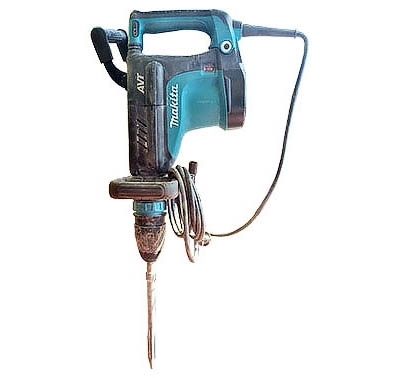
For the rental of an electric demolition hammer, Giffi Noleggi offers you the Makita HM1203 electric demolition hammer, powerful and sturdy, it can face any type of work without sacrificing manageability. This demolition hammer can carry out 950 to 1900 strokes per minute, its low weight of only 9.7 kg makes it easy and light to manoeuvre. With an impact power of 19.1 Joules it allows you to work even on the most difficult surfaces, and thanks to the SDS Max bits it allows you to carry out both demolition and drilling work by quickly replacing the tools. On this demolition hammer you can adjust the chisel to 12 different positions for a more flexible usability, moreover the electronic speed regulator allows you to carry out precise work even on the most delicate surfaces.
TECHNICAL FEATURES
Power consumption 1510 Watts
Impact power (EPTA) 19.1
joulesVibrations 16.5 m/
s2Dim. LxWxH576x128x265 mm
Cable length 5.0 mWeight
(EPTA) 9.7 kg
Strokes per minute 950 1900 c/min

It is a good idea to first work with our demolition hammer, have a stable position of the legs and position yourself perpendicular to the work surface. The stability of the body is fundamental and the position must be such as to be able to discharge all the energy on the demolition hammer, it is suggested to position your body by extending the weight forward towards the hammer. As regards the demolition function of materials such as rock, concrete or plaster, it is suggested to start the demolition from the outermost part of the surface to be demolished, gradually moving towards the inside, the work will be more precise in particular on the edges. Furthermore, if you have to carry out a superficial scraping work it is more usual to use a tool with a chisel tip, while if you want to make a hole & eacute; better to use a tool with a conical tip. In case of use of the demolition hammer to make holes and therefore of the rotary function, the surface on which the hole is to be made must be analysed, substantially the surfaces to be drilled are of three types summarised below:
1) Drilling of rocky and concrete surfaces:
For these types of surfaces, a specific tip for stone and concrete must be inserted and it is advisable to put the selector on a demolition hammer combined with the rotation, the rotation speed must be adjusted to the maximum in order to impart more energy on the hard surfaces to be drilled. If the material is more friable, such as siporex or plasterboard, it is advisable to move the selector only on rotation, excluding vibration, in this way you will avoid unwanted deformations of the circumference of the hole.
2) Drilling in wood and plastic:
As for this type of material it is better to use a wood drill for both wood and plastic, move the selector only on rotation and rotate the tool at a medium-low speed so that the hole does not fray and remains accurate.
3) Metal Drilling:
As for the drilling of metal surfaces, there are specific tips depending on the type of metal to be drilled, in most cases the tips for iron and titanium are sufficient, which cover almost all metal materials. In the event that the surfaces are particularly thick and the hole to be made is of a decent diameter, it is suggested to make a smaller hole first and then go over it with a larger tip.
1) The vacuum breaker must not be knocked as the empty shots cause premature wear
2) Absolutely do not use the tip as a lever, especially while the demolition hammer because the tool could break.
3) Absolutely do not use the tip of the demolition hammer to lift weights, this operation could be very dangerous both for the correct conservation of the tool which could break and for the user who could get injured.
4) Avoid repeatedly hitting the tool on the same point for a duration longer than 30 mins, the appliance could break.
5) Do not immerse the breaker in water or mud beyond the protrusion level of the tool, this could cause serious damage to the equipment and to the user.
Once it has been used, it must be carefully cleaned and placed in the special box.
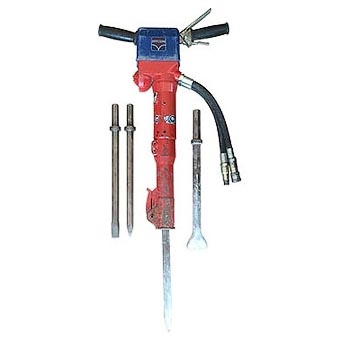
The Giffi Noleggi hydraulic breaker is a powerful work tool that allows you to demolish even the most resistant concrete surfaces thanks to the powerful motor including accessories, rent now
More information